



Two Meteor Showers Now, Lunar Eclipse Coming: U.S., West Coast, Oregon / Washington
Published 07/26/26 at 12:55 a.m.
By Oregon Coast Beach Connection Staff
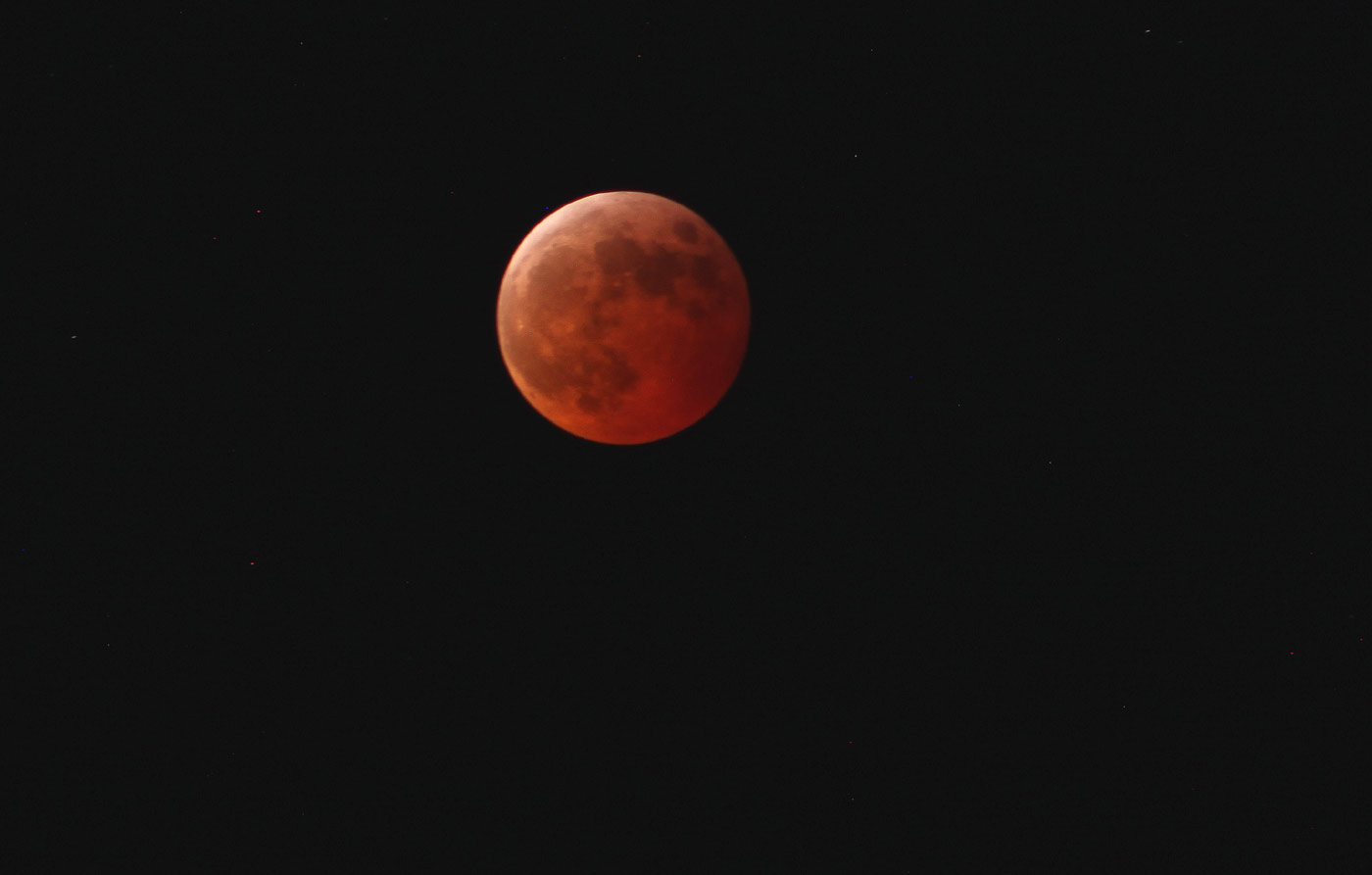
(Portland, Oregon) – Time to get your sky action on. Photo Oregon Coast Beach Connection: you'll see the moon turn dark orange at this eclipse.
Includes exclusive listings; some specials in winter
In Cannon Beach:
Includes rentals not listed anywhere else
In Manzanita, Wheeler, Rockaway Beach:
Some specials for winter
In Pacific City, Oceanside:
Some specials for winter
In Lincoln City:
Some specials for winter
In Depoe Bay, Gleneden Beach:
Some specials for winter
In Newport:
Look for some specials
In Waldport
Some specials for winter
In Yachats, Florence
Some specials for winter
Southern Oregon Coast Hotels / Lodgings
Reedsport to Brookings, places to stay; winter deals
Late July and especially August are getting ready to create quite a show across the globe and most of the U.S. and Americas, with two meteor showers already kicking in and a nearly complete lunar eclipse. Whether you're inland or on the Washington coast or Oregon coast, it's all going to be – of course – about the weather. But August is usually fairly kind in that regard.
The Delta Aquariids produce a steady flow of meteors rather than a single, exact peak. Activity increases in late July and continues into early August, blending with the rising Perseids. The radiant climbs into view in mid-evening, reaches its highest point around 2 a.m., and drops low again by dawn. In 2026, the full moon arrives on July 29, so the clearest viewing opportunities come during the moon-free early-morning hours in the week before that date.
Under ideal dark-sky conditions, observers may see 15 to 20 meteors per hour, with many Delta Aquariids appearing alongside early Perseids as August begins.
The Perseids strengthen gradually through early August and then decline quickly after their peak. In 2026, the predicted peak falls on August 13, making the mornings of August 12 and 13 the prime viewing window. August 14 may still offer good activity, though the shower typically fades rather rapidly.
Here's the plus side: the 2026 incarnation has a new moon on August, which ensures dark skies for the peak.
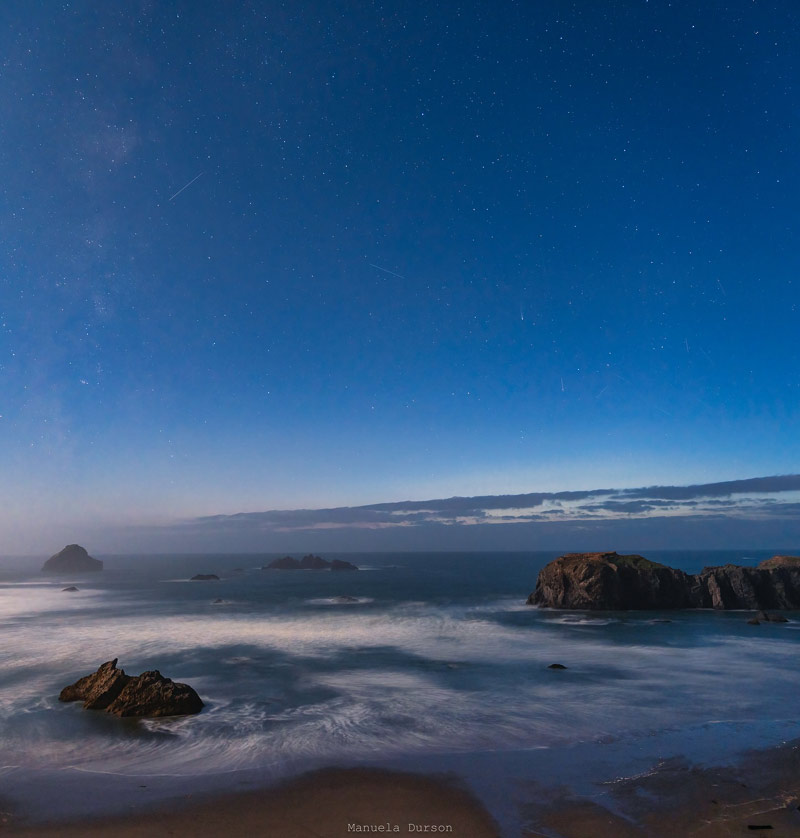
Photo Manuela Durson - Manuela Durson Fine Arts - Bandon just after dark, showing a comet and some satellite action.
“The Perseids are best viewed in the Northern Hemisphere during the pre-dawn hours, though at times it is possible to view meteors from this shower as early as 10 p.m.,” said NASA.
See more Oregon / Washington Astronomy.
Pacific Northwest Weather | Oregon, Washington, Coastline (see NW from space) |---| Washington Coast Weather |---| Oregon Coast Weather |---| Inland Oregon Weather
The radiant rises late in the evening and reaches its highest point near dawn. Observers watching the total solar eclipse on August 12 may even catch a few Perseids during totality. Under good dark-sky conditions, peak rates often exceed 90 meteors per hour.
“Perseids are also known for their fireballs. Fireballs are larger explosions of light and color that can persist longer than an average meteor streak,” said NASA. “This is due to the fact that fireballs originate from larger particles of cometary material. Fireballs are also brighter, with apparent magnitudes greater than -3.”
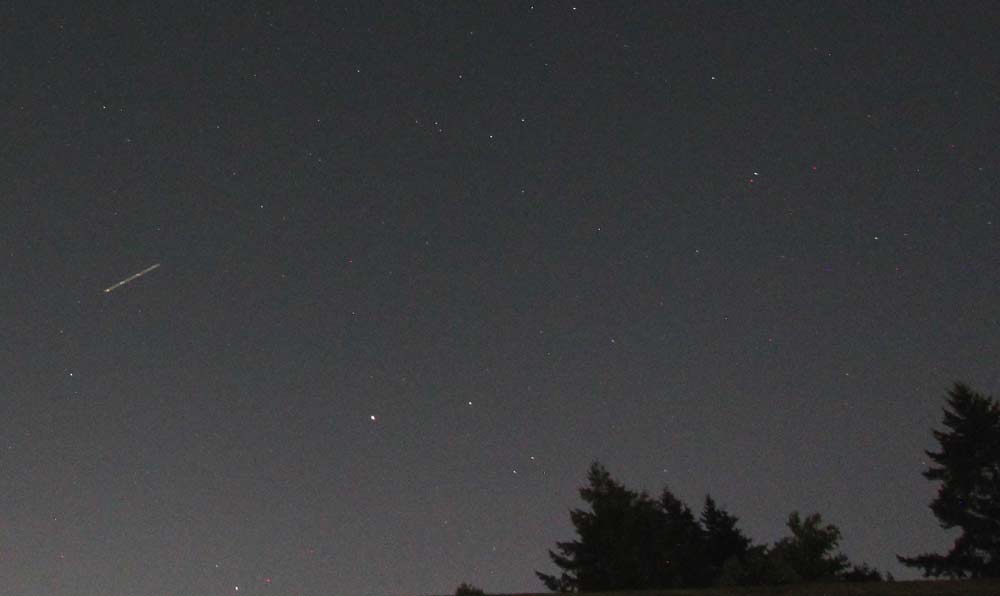
Shooting star in Portland / Oregon Coast Beach Connection
Partial Lunar Eclipse for U.S., West Coast
A partial lunar eclipse will be visible across Portland, western Oregon, and much of Washington on the evening of August 27, 2026. The eclipse begins at 7:49 p.m., though the moon will still be below the horizon at that point. It reaches maximum at 9:12 p.m., when the moon will be about 12 degrees above the east-southeast horizon with a magnitude of 0.930. The event ends just after midnight at 12:01 a.m., lasting a little over four hours.
However, for the Pacific Northwest it's going to be a bit difficult. Because the moon rises during the total phase, it will appear extremely dim and may be difficult to see until it climbs higher or the darkest portion of the eclipse ends. Observers should look toward roughly 103 degrees east-southeast as the moon comes up.
Times are about equal for northern Washington areas – like Seattle – but it'll start to shift the farther east you go into Oregon and Washington. Farther north it'll be just a little bit lower as well.
Areas just east of the West Coast, like Nevada, Idaho, etc., will get better views, along with the rest of the U.S.
Delta Aquariids
Dates: July 18 – August 21
Peak: Predicted July 30, 2026 though the shower does not produce an exact peak
Best viewing: Late July through early August, from midnight until dawn
Perseids
Dates: July 14 – September 1
Peak: Predicted August 13, with the strongest activity on the mornings of August 12 and 13
Best viewing: Late night through dawn under a new-moon sky
Oregon Coast Beach Connection will soon have a piece about what one spot on the Oregon coast may be best to see interstellar phenomenon – and the actual science behind it.
Oregon Coast Hotels for this event - South Coast Hotels - Oregon Coast Vacation Rentals - Where to eat - Maps - Virtual Tours


















OREGON COAST HOTEL REVIEWS (hit refresh to see different reviews)
5 Astounding Balcony Views on Oregon Coast
Exceptional views and finds around Cannon Beach, Lincoln City, Newport. Cannon Beach hotel reviews, Manzanita hotel reviews, Lincoln City hotels, Newport hotel reviews. Tolovana Inn, Shearwater Inn, Inn at Nye Beach, Keystone Vacation Rentals
Central Oregon Coast's Summerlike Sept and Oct Getting Booked Up - Some Renta...
Lincoln City's Keystone: brief rental openings in Sept, slightly more Oct. Lincoln City hotel reviews. Depoe Bay hotel reviews
A True 'Pacific Treasure' on Oregon Coast, Rental Overlooks Lincoln City Cal...
7 Sep 2026 at 11:21pm
Keystone Vacation Rentals reviews: Right by the largest set of tidepools in Lincoln City. Closest to Depoe Bay seawall, Whale Watching Center. Lincoln City hotel reviews
Pacific City Hotels, Lodging
Pacific City Hotels, Lodging, hotel Pacific City hotel reviews, vacation rentals
More About Oregon Coast hotels, lodging.....
More About Oregon Coast Restaurants, Dining.....
 |
 |
 |
Washington Coast / Oregon Coast Articles (stories are random: hit reload to see different articles)
First Big Freeze for Washington, Oregon - Gnarly Sneaker Waves Parts of Coast10 Oct 2026 at 9:25am
Frost advisories Seattle, Portland, Valley, Coast Range, Central Oregon, Hood River Valley. Weather
Central Oregon Coast's Siuslaw Forestlands Will Begin Seeing Pile-Burning
28 Sep 2026 at 8:31am
It begins in the central coast and Hebo areas. Tillamook, Lincoln City, Nehalem, Manzanita, Garibaldi, Pacific City, Depoe Bay, Yachats, Florence, Reedsport
Two S. Oregon Coast Parks' Trails to be Closed Temporarily: Humbug, Cape Blanco
9 Oct 2026 at 8:49pm
Trail systems at Humbug Mt and Cape Blanco closed for just a short while. Port Orford, Gold Beach, Langlois
October Vacation Rental Deals in Lincoln City - Central Oregon Coast. A1 Beach Rentals
2 Oct 2026 at 8:05am
Some rates lower than most motels. Lincoln City
Ocean's Edge Wayside or Oregon Coast Access #27: Rockaway Beach's Center Has Many Faces
2 Oct 2026 at 7:55am
The main access goes by various names but really it's just Rockaway Beach
An Oregon Coast Landmark Needs Your Help: Oceanside Tunnel Work Party
20 Sep 2026 at 6:46am
Friday, October 2, help clean up the Oceanside tunnel. Oceanside events, Tillamook events, Pacific City events
Best Rooms with Views of Haystack Rock, Cannon Beach
7 Oct 2026 at 9:15am
Great balconies and a close walk to Haystack. Tolovana Inn. Cannon Beach reviews
Lincoln City in Fall: Second Summer on Oregon Coast, Kites, Brews, Misty Hikes
13 Sep 2026 at 8:32pm
Ale Trail and scenic hiking routes to the city?s popular Exploriences. Lincoln City events
Back to Oregon Coast
Contact Advertise on Oregon Coast Beach Connection
All Content, unless otherwise attributed, copyright © Oregon Coast Beach Connection. Unauthorized use or publication is not permitted


Oregon
Coast Hotels
S. Coast Hotels
Astoria/Warrenton Hotels
Seaside Hotels
Cannon
Beach Hotels
Nehalem Bay Lodgings
Manzanita Hotels, Lodging
Rockaway Beach Hotels
Three Capes Lodging
Pacific City Hotels, Lodging
Lincoln
City Hotels
Depoe
Bay Hotels
Newport Hotels
Waldport Hotels
Yachats
Hotels
Florence Hotels
Reedsport Hotels
Coos Bay Hotels
Bandon Hotels
Port Orford Hotels
Gold Beach Hotels
Brookings Hotels
Oregon
Coast Vacation Rentals
Oregon
Coast Lodging Specials
South Coast Hotels
Dining
Guide
Seaside
Cannon
Beach Dining
Manzanita,
Rockaway, Wheeler Dining
Pacific
City, Oceanside, Netarts, Tierra Del Mar Restaurants
Tillamook
Bay Restaurants, Dining
Lincoln
City Dining, Restaurants
Depoe
Bay Restaurants, Dining
Newport Restaurants, Dining
Waldport,
Yachats Restaurants, Dining
Florence Restaurants, Dining
Restaurant
Reviews
Coast
Events Calendar
Astoria
Seaside,
Cannon Beach Calendar
Manzanita,
Rockaway Events
Tillamook,
Pacific City Calendar
Lincoln
City Events Calendar
Newport,
Depoe Bay Events Calendar
Yachats Events Calendar
Oregon Coast Complete Guides every beach access, attraction
Search for Oregon Coast Subjects, Articles
Explore Every Beach Spot


News Headlines from All Over Oregon Need to scan Oregon headlines? Constantly updated news from all over Oregon: a comprehensive, up-to-the-minute display of news headlines from a variety of media
Oregon Coast Oceanfront Lodging, Hotels, Rentals