



Another Gray Whale Washes Up on Oregon Coast, at Seaside: Early Observations, Video
Published 04/14/26 at 7:55 p.m.
By Oregon Coast Beach Connection Staff
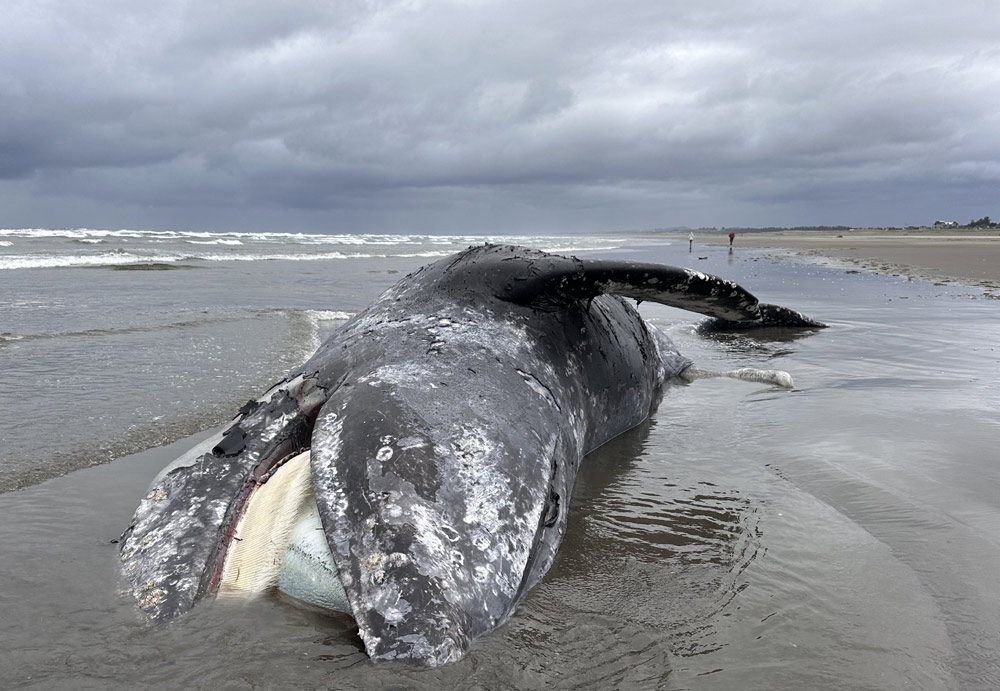
(Seaside, Oregon) – They knew it was out there a few days ago. The US Coast Guard had alerted staff at the Seaside Aquarium that it had been seen floating off Tillamook Head, about six miles away. (Photos and video Seaside Aquarium / Tiffany Boothe)
Includes exclusive listings; some specials in winter
In Cannon Beach:
Includes rentals not listed anywhere else
In Manzanita, Wheeler, Rockaway Beach:
Some specials for winter
In Pacific City, Oceanside:
Some specials for winter
In Lincoln City:
Some specials for winter
In Depoe Bay, Gleneden Beach:
Some specials for winter
In Newport:
Look for some specials
In Waldport
Some specials for winter
In Yachats, Florence
Some specials for winter
Southern Oregon Coast Hotels / Lodgings
Reedsport to Brookings, places to stay; winter deals
Then the deceased cetacean made landfall Tuesday morning, coming ashore at Seaside. The sixth dead gray whale to show up on Northwest beaches in less than a month, this one is a male and about 40 feet long. It had been dead for some time – you could tell by the smell, according to the aquarium's Tiffany Boothe.
“A necropsy has been scheduled for later this week,” Boothe said. “While the goal of any necropsy is to determine the cause of death, every necropsy is unique, and we learn from each one.
Aquarium manager Keith Chandler told Oregon Coast Beach Connection that after the Coast Guard told him about it floating far off, he was hoping it would land on Tillamook Head. Instead, it ended up in the aquarium's front yard – literally.
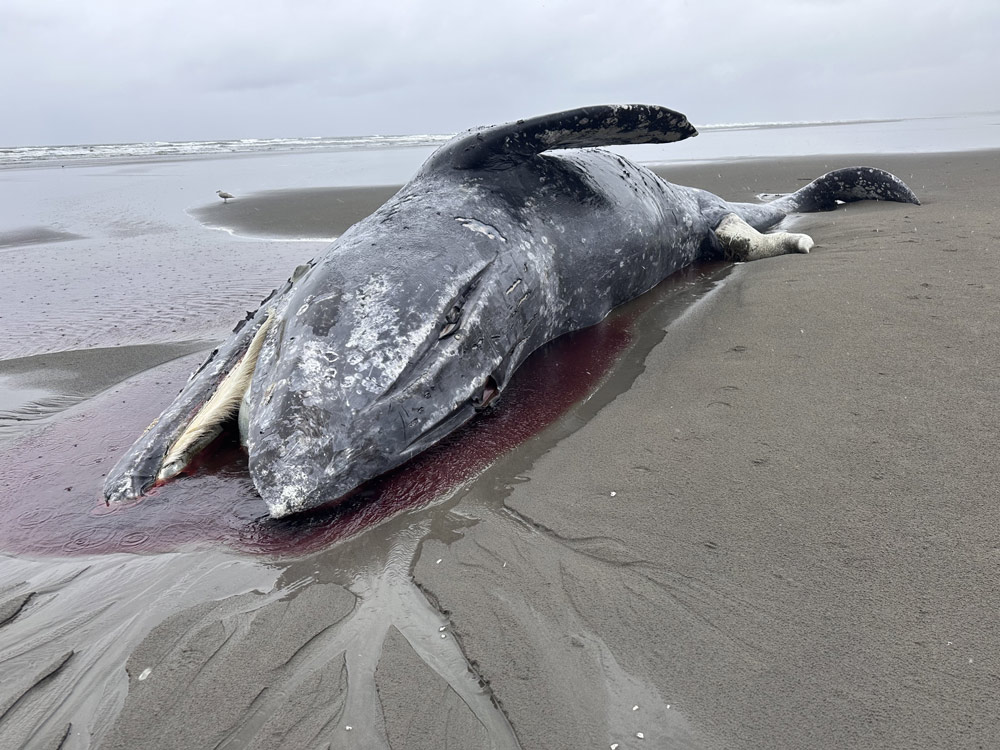
This follows another that came up on the central Oregon coast a few days ago. Before that, three dead gray whales happened in the space of a few days on the Washington coast, and on March 26 another was found at Florence. See Another Dead Whale Stranding, This Time Near Yachats on Central Oregon Coast
Boothe said it looked like it might be malnourished, but since the body was fairly bloated it's hard to tell.
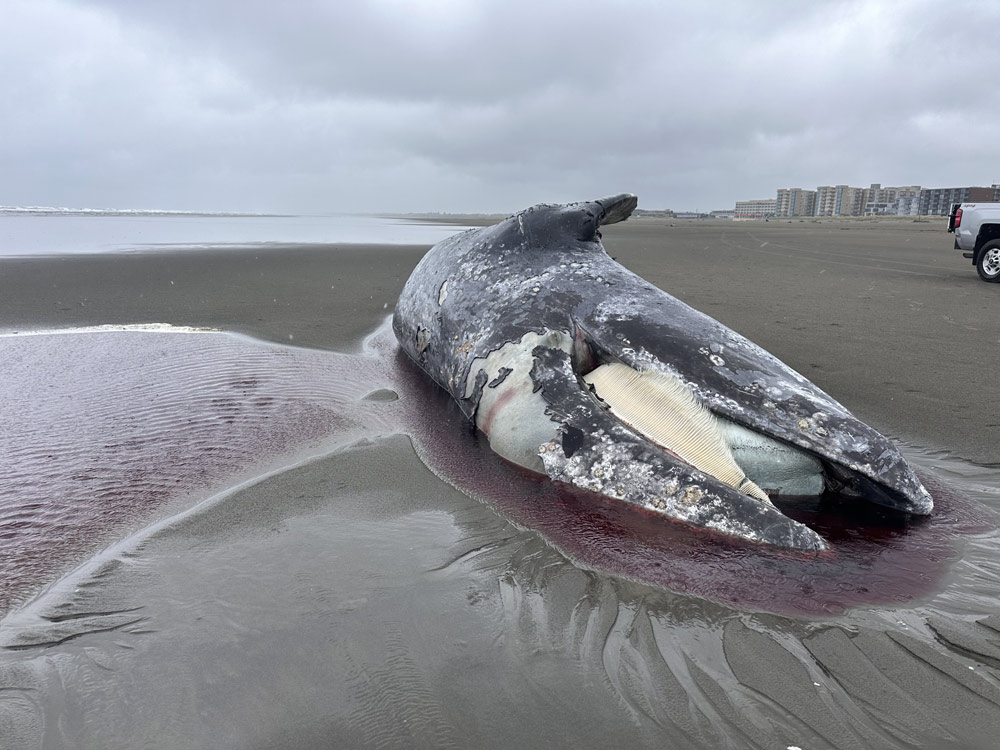
Julie Conrad, a whale researcher from the central Oregon coast, examined the photos Oregon Coast Beach Connection sent her. While she has not seen it upclose, she offered what observations could be made from the photos.
“No obvious signs of trauma,” Conrad said. “The blood is likely post mortem from scavengers. They go for soft tissue.”
She said the photos seem to indicate it could be underweight, but only the actual necropsy will be able to show more. One sign of that is a sunken area behind the head of the whale, which Conrad said is somewhat visible in the photo but not certain. The spine would be showing on a severely emaciated whale.
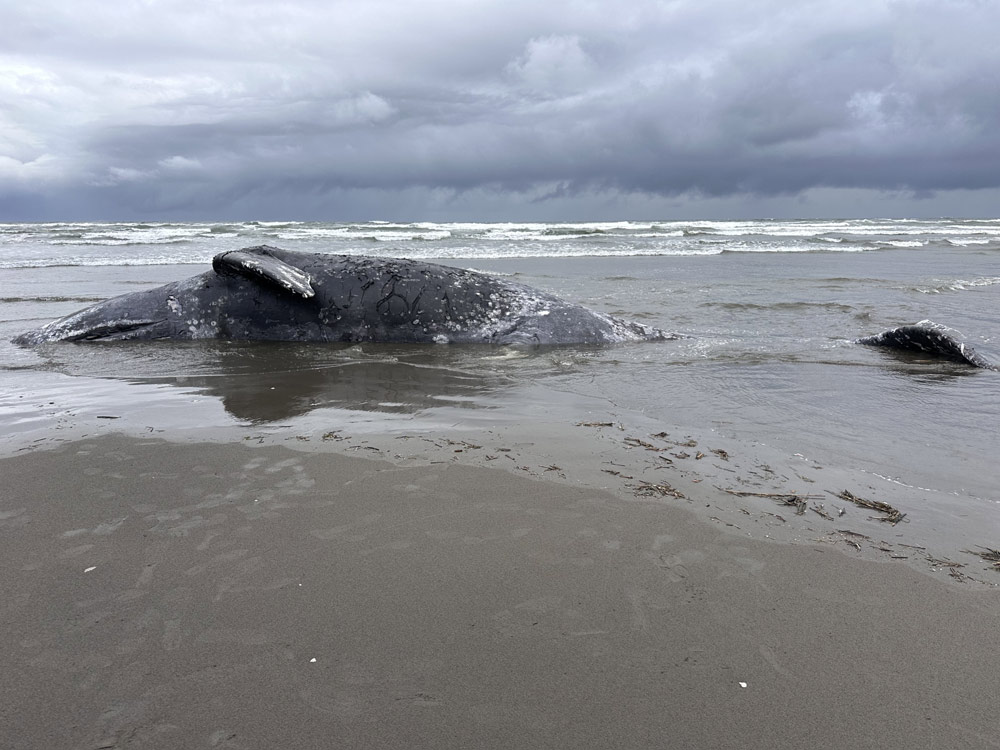
That's the issue with this run of dead gray whales, which has far exceeded what scientists usually see by this time of year. They are showing up malnourished to varying degrees. Part of the frequency is because they're migrating in great numbers – so more are dying along the way. It's the emaciated or malnourished state that's concerning.
In March, the Marine Mammal Stranding Network's (MMSN) Jim Rice talked to Oregon Coast Beach Connection about the whale at Florence.
“We know that lots of gray whales have been stranding along the entire west coast since 2019," Rice said. "The bottom line is that these whales are having a hard time finding enough to eat during their summer foraging seasons in the arctic, causing many of them to become malnourished."
For background see the article 'Skinny Whales' Remain Issue on Washington / Oregon Coast, But May Be Lessening
For this Seaside whale, the necropsy is next, where photos and measurements are taken.
“Then, the team peels back the blubber layer to look for signs of trauma like hemorrhage (bruising), measures the blubber thickness, and examines the overall 'health' of the blubber (color, oil content, texture, etc.),” Boothe said. “Samples of the blubber are taken and sent to a lab for further analysis. This may sound easy, but it can be quite a task. The blubber is thick and heavy. It can be hard to cut through and even harder to peel down due to the weight.”
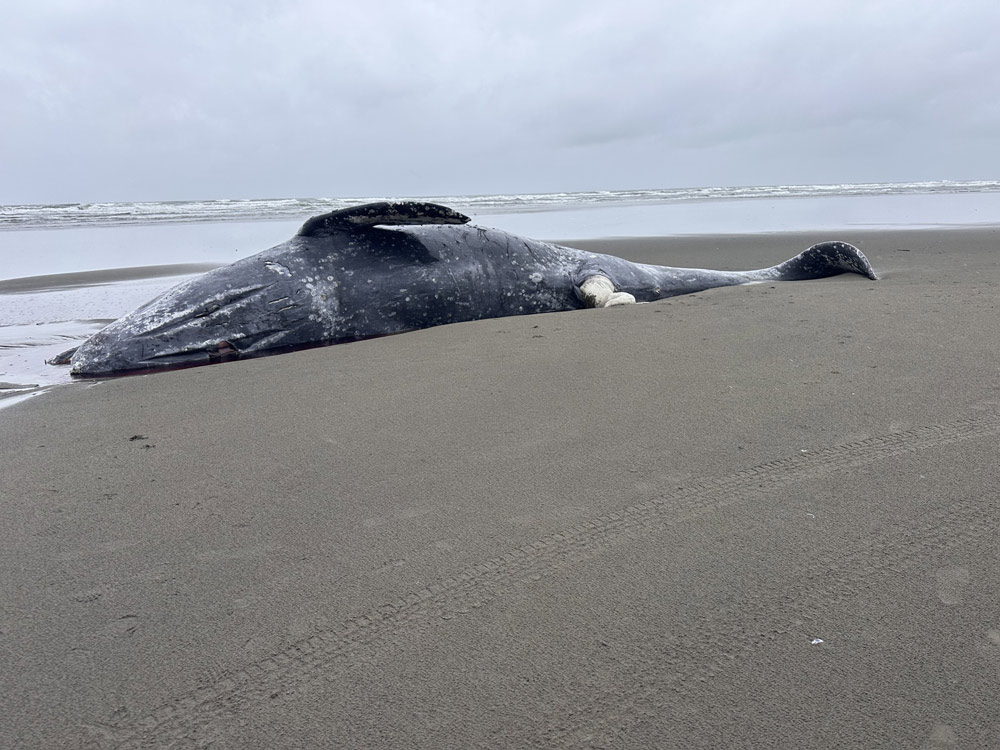
The team then looks for any signs of cancers or other issues, examining organs – including all three stomachs. Yes, Boothe said, they have three. The team ends up coming together and pooling their knowledge, but an actual cause of death is not always certain.
As always, social media responses to these stories includes an endless array of “don't blow'em up” posts – as if the joke wasn't already made over one million times.
“So, what happens now? ,” Boothe said. “It depends. Though smelly, it is best for the environment for the whale to remain unburied on the beach. The whale provides food for a wide range of scavengers, and as it decomposes, nutrients are transferred into the surrounding sand. However, there are times and places where a whale cannot simply remain on the beach. In those cases, the whale is buried or removed.”
Oregon Coast Hotels in this area - South Coast Hotels - Oregon Coast Vacation Rentals - Where to eat - Maps - Virtual Tours




















OREGON COAST HOTEL REVIEWS (hit refresh to see different reviews)
Two Stellar Oregon Coast Winter Views at Cannon Beach Include One Sizzling Sp...
Watch king tides, storms from here, walk Lewis 'n Clark history. Cannon Beach lodging, Cannon Beach hotel reviews, Manzanita hotel reviews
Dreamy Port Orford's Hotels, Rentals, Inns - Unique Rooms of the South Oregon...
Variety of hotels, vacation rentals and BnB's that stand out. Hotel reviews
Lincoln City's Coho Oceanfront Lodge: Lincoln City Hotel Reviews
The Coho has a large roster of perks - a kind of upscale without all of that price tag. It Continues Pushing Boundaries on Oregon Coast. Gleneden Beach
A Soaring View Just Opened This Week at North Oregon Coast's Neskowin
Right on the ocean, it's been drawing attention lately. Availability. Pacific City Hotel reviews
More About Oregon Coast hotels, lodging.....
More About Oregon Coast Restaurants, Dining.....
 |
 |
 |
Washington Coast / Oregon Coast Articles (stories are random: hit reload to see different articles)
Astoria / Warrenton Oregon Coast Virtual Tour: Complete Guide, Every Beach / Attraction, Maps, Travel News13 Jul 2026 at 9:18pm
Every beach access, attraction, updated travel news, maps, mileposts: Hammond, Warrenton, Skipanon, Astoria
Rockaway Beach Gets a Walking History Guide: Stroll Into Oregon Coast's Past
13 Jul 2026 at 9:20pm
The digital walking tour through STQRY.com let's you time travel. Manzanita, Nehalem, Garibaldi
Photos: Aurora Borealis Show Hits a High Note Above Oregon
5 Jul 2026 at 6:29am
Northern Lights documented even in southern Oregon, the coast. Weather, astronomy, sciences, Lincoln City, Florence, Salem, Bend
Reedsport / Winchester Bay Oregon Coast Weather Forecasts and Alerts | Current Conditions, Cams | Ocean Temps | Tides
2 Jul 2026 at 6:48am
Weather forecasts, alerts, cams, ocean temperatures and tide information for Reedsport and Winchester Bay
Oregon Coast's 70-Foot Blue Whale Skeleton Gets a Dedication Day, Special Newport Events
13 Jul 2026 at 9:20pm
July 16 brings the special days, with speakers and a whale sounds event. Marine sciences
Orange Skies and Heat Advisories for Oregon, Washington, Portland - Air Alerts Central Oregon
21 Jul 2026 at 10:03pm
Heat advisories in the north, air quality alerts central Oregon. Thunderstorms possible. Weather, Astoria, Brookings, Eugene, Bend, Deschutes County
Oregon Coast Jazz Party Announces Lineup in Newport - October
27 Jun 2026 at 11:23pm
October 2 - 4 in Nye Beach, Newport. Newport events
Fourth of July Weekend Around Oregon, Washington Warms Up and Summer's Back
3 Jul 2026 at 12:37am
Temps back to summer along the coastline, Portland, Eugene, Bend, Seattle. Weather
Back to Oregon Coast
Contact Advertise on Oregon Coast Beach Connection
All Content, unless otherwise attributed, copyright © Oregon Coast Beach Connection. Unauthorized use or publication is not permitted


Oregon
Coast Hotels
S. Coast Hotels
Astoria/Warrenton Hotels
Seaside Hotels
Cannon
Beach Hotels
Nehalem Bay Lodgings
Manzanita Hotels, Lodging
Rockaway Beach Hotels
Three Capes Lodging
Pacific City Hotels, Lodging
Lincoln
City Lodging
Depoe
Bay Hotels
Newport Hotels
Waldport Lodging
Yachats
Hotels
Florence Hotels
Reedsport Hotels
Coos Bay Hotels
Bandon Hotels
Port Orford Hotels
Gold Beach Hotels
Brookings Hotels
Oregon
Coast Vacation Rentals
Oregon
Coast Lodging Specials
South Coast Hotels
Dining
Guide
Seaside
Cannon
Beach Dining
Manzanita,
Rockaway, Wheeler Dining
Pacific
City, Oceanside, Netarts, Tierra Del Mar Restaurants
Tillamook
Bay Restaurants, Dining
Lincoln
City Dining, Restaurants
Depoe
Bay Restaurants, Dining
Newport Restaurants, Dining
Waldport,
Yachats Restaurants, Dining
Florence Restaurants, Dining
Restaurant
Reviews
Coast
Events Calendar
Astoria
Seaside,
Cannon Beach Calendar
Manzanita,
Rockaway Events
Tillamook,
Pacific City Calendar
Lincoln
City Events Calendar
Newport,
Depoe Bay Events Calendar
Yachats Events Calendar
Oregon Coast Complete Guides every beach access, attraction
Search for Oregon Coast Subjects, Articles
Explore Every Beach Spot


News Headlines from All Over Oregon Need to scan Oregon headlines? Constantly updated news from all over Oregon: a comprehensive, up-to-the-minute display of news headlines from a variety of media
Oregon Coast Oceanfront Lodging, Hotels, Rentals