



In Search of More Oregon Coast Ghost Forests - Where to Find Ghost Forests
Updated Periodically
Includes exclusive listings; some specials in winter
In Cannon Beach:
Includes rentals not listed anywhere else
In Manzanita, Wheeler, Rockaway Beach:
Some specials for winter
In Pacific City, Oceanside:
Some specials for winter
In Lincoln City:
Some specials for winter
In Depoe Bay, Gleneden Beach:
Some specials for winter
In Newport:
Look for some specials
In Waldport
Some specials for winter
In Yachats, Florence
Some specials for winter
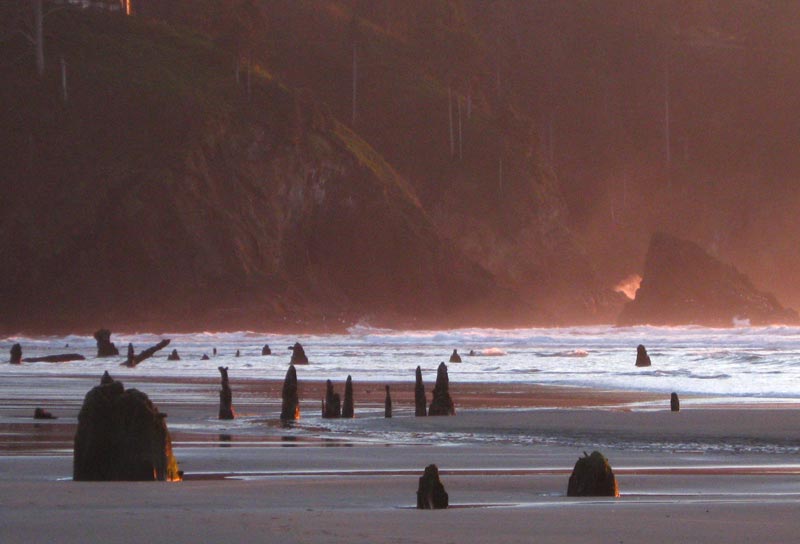
(Oregon Coast) – They're called “ghost forests” partially for their ghostly appearance and for the fact they are the remnants of ancient forests often a few thousand years old. And it seems there are more locations along the Oregon coast where you can find them than you may have realized – but they may be disappearing (above: Neskowin's ghost forest).
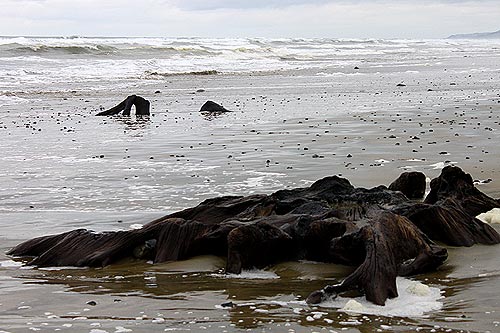
According to a paper published in 2006 by Portland geologist Dr. Curt Peterson and Newport geologist Roger Hart (Hart passed away a few years ago), there are 45 locations along the Oregon coast where they can be found – over half of which are on the central coast area, in and around Newport and south of Lincoln City. Those found just south of Cannon Beach, in and around Arch Cape - like the ones at Neskowin, Seal Rock and just north of Newport - are the most well-publicized. It notes several locations on the south coast as well
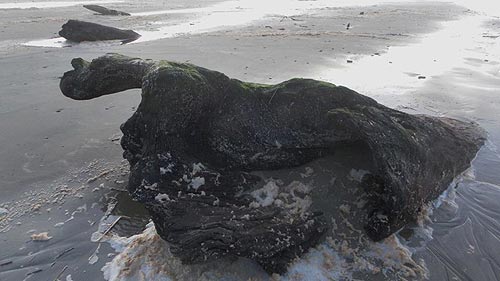
These ghost forests are nothing short of jaw-dropping, if you know what you're seeing. At first, they appear like old manmade pilings in the surf, as if it was an old pier structure left abandoned. But they are parts of a forest that can be thousands of years old. Radiocarbon dating of these stumps has put them as old as 5,000 years to some as young as 1400 years old – depending on the location.
The paper also references about 44 spots along the entire coastline these can be found embedded in cliffs. Oregon Coast Beach Connection will not disclose these for safety reasons.
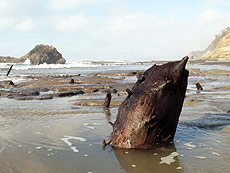 |
| Ghost forest at Arch Cape (photo courtesy Seaside Aquarium) |
Exactly why these exist is a bit spooky too, and a little puzzling. What is known is that they were buried beneath the sand for millennia and thus preserved by being deprived of the decaying effects of oxygen, not to mention being battered out of existence by the tides.
How they were buried is fascinating, and it appears there are two major theories on this. It turns out one is pure rumor, however.
The true and proven theory put forth by Hart and Peterson a few years back is that some slower process, perhaps by a few decades, caused the landscape to change and the forests were choked by incoming sand dunes, a swamp of some sorts or the sand that now buries them.
Most media outlets tend to lean towards something even spookier: the theory that some major cataclysmic event, like the tsunamis this area has experienced over and over, covered them up. This idea has been long debunked and is simply not true.
Part of the reason this has been propagated is misunderstanding. There are other ghost forests found in estuaries, such as Necanicum, Nehalem, Siletz - essentially all coastal estuarties, according to geologist Tom Horning. Some have them from different millennia, but all have some that came from the 1700 A.D. tsunami. This is a big revelation to many coastal fans: there are many more ghost forests than people know about.
Most, if not all except the forest at Neskowin, are only visible when sand levels drop below a certain level. Neskowin is usually visible year-round, while the others appear only rarely, during winters when sand drops quite a bit in that area.
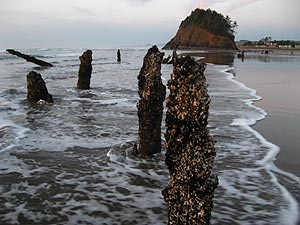 |
| Neskowin |
According to Hart and Peterson's paper, they are found along the following spots (although the paper does not always indicate exactly where):
In Tillamook County, along the Three Capes Loop, they're found at Oceanside, just north of Cape Kiwanda, Cape Lookout State Park, Sand Lake and Neskowin. In the Lincoln City and Depoe Bay area, they're listed as found at Road's End at Lincoln City and two areas of Lincoln Beach. One is found year-round just beneath Otter Crest on the southern side. In Newport and Seal Rock they're around Yaquina Head (Moolack Beach), two parts of Nye Beach, near Yaquina Bay, Theil Creek, Lost Creek, Seal Rock (Curtis Street), and two spots around Driftwood State Park. In Waldport, they can be seen around the Bay Shore area, just south of town, at Big Stump Beach, three areas around Beachside State Park and two around Tillicum State Park. Numerous ones are found on the southern Oregon coast as well, such as near Florence, Reedsport, Gold Beach, Bandon and Brookings.
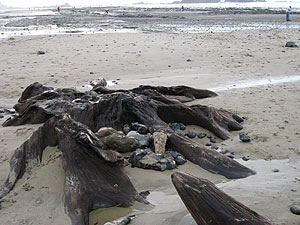 |
| Seal Rock |
Around Yachats, they can be found in the sandy spots near Idaho Street, Oregon Street, Vingie Creek, near the Silver Surf Motel - and mysteriously the paper indicates in Yachats itself. This is odd because that whole shoreline is rocky basalt shelf areas, so the authors could be referring to the bay in town or in the sea cliffs.
South of there, into Lane County, they are listed at Ten Mile Creek area, Ponsler Wayside, Heceta Head, the Coast Guard station at Florence, and at Five Mile Point.
On the southern Oregon coast, there are listings for Whiskey Run, Bandon, Blacklock Point, Nesika Beach, Otter Point and Crook Point (near the towns of Brookings and Gold Beach).
The paper doesn't look deeply into those sometimes found at Arch Cape and Hug Point, just south of Cannon Beach.
Hart and Peterson noted an absence of these at various locations, such as around Port Orford, Humbug area, Langlois, Coos Bay or Rockaway Beach and Manzanita,
“Probably because these beaches are not eroding,” the authors said.
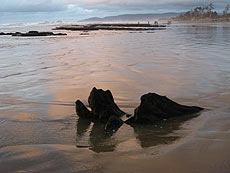 |
| Stumps at Cape Lookout |
There is also the possibility other ghost forest stumps have existed in these spots before, but they have been eroded away. Some areas, like those at Cape Lookout and Neskowin, are experiencing sand levels that continue to drop and some of these ghost forest stumps have already gone, torn out by the sea.
At the Newport office of the Oregon Department of Geology and Mineral Industries, coastal geomorphologist Jonathan Allan said those at Cape Lookout have been dated at 1400 years old, but there could have been older ones here earlier and elsewhere, and they may have disappeared as those at Neskowin are beginning to.
Those around Newport are often found to be around 4,000 years old.
It is illegal to take any pieces of these away, according to state and federal law. Thus, Oregon Coast Beach Connection is not giving away the exact location of all of these ghost forest spots.
The paper is called “Earth Surface Processes and Landforms” and is available at http://onlinelibrary.wiley.com/.
Oregon Coast Hotels for this event - Where to eat - Map - Virtual Tour














Cannon Beach Lodging
Nehalem Bay Lodgings
Manzanita Hotels, Lodging
Three Capes Lodging
Pacific City Hotels, Lodging
Lincoln City Lodging
Depoe Bay Lodging
Newport Lodging
Waldport Lodging
Yachats Lodging
Oregon Coast Vacation Rentals
Oregon Coast Lodging Specials


At Tilllcum Beach
Seal Rock
More About Oregon Coast hotels, lodging.....
More About Oregon Coast Restaurants, Dining.....


LATEST Related Oregon Coast Articles
16 Oct 2026 at 9:26am
Play hooky from work: temps in 70s, lots of sun, the ISS, and then crazy waves. Weather, astronomy
Seaside Event Digs Deep Into History of Oregon Coast's Highway 101
16 Oct 2026 at 9:24am
101 at 100 ? The History of Oregon?s Most Iconic Highway at Seaside Brewing on October 29
N. Oregon Coast Native American Culture Celebrations For Two Days at Bay City
16 Oct 2026 at 9:22am
November 6 - 7, at the Bay City Arts Center on Tillamook Bay. Tillamook events, Pacific City events, Garibaldi,
Festive and Family-Friendly on Oregon Coast: Florence Hotel Gets Lighthearted...
16 Oct 2026 at 9:21am
Haunted Hotel event on Saturday, Oct. 31 - with treats for adults too. Florence events
Artemis II Moon Pioneer Christina Koch Moves to Management
14 Oct 2026 at 2:56am
She concludes more than 35 years with NASA on Oct. 21. Astronomy
SOLVE's Inland Oregon River Cleanups Get the Wacky Finds As Well
13 Oct 2026 at 11:31pm
Last of the waterways cleanups wrapped up in Sept: Medford, Clackamas, Portland, Ashland, Gladstone
Nehalem Event Explores Theories About Francis Drake on Oregon Coast
13 Oct 2026 at 3:31am
Saturday, October 24 at North County Recreation District in Nehalem. Manzanita events, Tillamook events, Cannon Beach events
Celtic Music Season Rages on Central Oregon Coast, Begins October
12 Oct 2026 at 8:08am
2026-27 Celtic Series starts this week in Lincoln City. Lincoln City events, Pacific City events
Back to Oregon Coast
Contact Advertise on BeachConnection.net
All Content, unless otherwise attributed, copyright BeachConnection.net Unauthorized use or publication is not permitted


Oregon
Coast Hotels
Seaside Hotels
Cannon
Beach Hotels
Nehalem Bay Lodgings
Manzanita Hotels, Lodging
Rockaway Beach Hotels
Three Capes Lodging
Pacific City Hotels, Lodging
Lincoln
City Lodging
Depoe
Bay Hotels
Newport Hotels
Waldport Lodging
Yachats
Lodging
Oregon
Coast Vacation Rentals
Oregon
Coast Lodging Specials
South Coast Hotels
Dining
Guide
Seaside
Cannon
Beach Dining
Manzanita,
Rockaway, Wheeler Dining
Pacific
City, Oceanside, Netarts, Tierra Del Mar Restaurants
Tillamook
Bay Restaurants, Dining
Lincoln
City Dining, Restaurants
Depoe
Bay Restaurants, Dining
Newport Restaurants, Dining
Waldport,
Yachats Restaurants, Dining
Florence Restaurants, Dining
Restaurant
Reviews
Coast
Events Calendar
Astoria
Seaside,
Cannon Beach Calendar
Manzanita,
Rockaway Events
Tillamook,
Pacific City Calendar
Lincoln
City Events Calendar
Newport,
Depoe Bay Events Calendar
Yachats Events Calendar
Oregon Coast Complete Guides every beach access, attraction
Search for Oregon Coast Subjects, Articles
Explore Every Beach Spot


News Headlines from All Over Oregon Need to scan Oregon headlines? Constantly updated news from all over Oregon: a comprehensive, up-to-the-minute display of news headlines from a variety of media
Oregon Coast Oceanfront Lodging, Hotels, Rentals
Book Coastal Lodging Now
Booking.com