




Oregon Coast (And Inland) Astronomy: Five Planets Put on Show
Published 03/08/2018 at 12:55 AM PDT
By Jim Todd, OMSI (and OCBC staff)
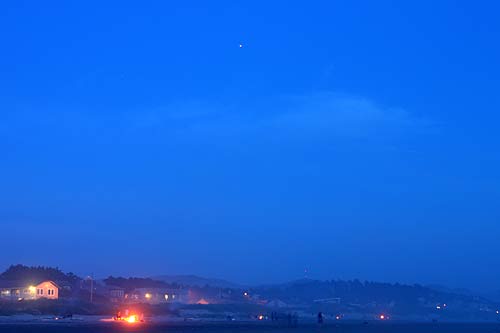
(Oregon Coast) - For the past few days, the morning skies been mostly clear and cold, viewers quickly noticed the visible planets and moon appearance above the eastern and southern horizon. Before sunrise, from March 7 to 11, the waning moon will pass by the morning planets, Jupiter, Mars and Saturn. Meanwhile, the evening planets, Venus and Mercury, are putting on a show after sunset. (Above: the planet Mars over Manzanita).
For those on the Oregon coast and other parts of the state, you’re getting a fascinating display above.
Includes exclusive listings; some specials in winter
In Cannon Beach:
Includes rentals not listed anywhere else
In Manzanita, Wheeler, Rockaway Beach:
Some specials for winter
In Pacific City, Oceanside:
Some specials for winter
In Lincoln City:
Some specials for winter
In Depoe Bay, Gleneden Beach:
Some specials for winter
In Newport:
Look for some specials
In Waldport
Some specials for winter
In Yachats, Florence
Some specials for winter
Starting with Jupiter, the brightest of the morning planets. Jupiter is the fifth planet from the Sun and the largest in the Solar System. Jupiter is primarily composed of hydrogen with a quarter of its mass being helium.
On March 7th, the waning gibbous moon appeared just above the Jovian planet. Jupiter, rises around midnight in early this month, and it shines at magnitude of -2.21 above the southern horizon at dawn. Jupiter will be visible in the evening sky through November 2018.
To the east of Jupiter are the planets Mars and Saturn. Both Mars and Saturn shine brightly at magnitude of 1. During the month of March, Mars appears between Jupiter and Saturn. Saturn appears pale yellow hue while Mars is red. Located between Jupiter and Mars, is the brightest star of Scorpius, Antares, a red giant star, should not be confused for Mars.
For Mars, the waning gibbous moon will pass nearby on March 9 and 10. Mars is the fourth planet from the Sun and the second-smallest planet in the Solar System after Mercury. It is nearly half the size of Earth. Mars is a terrestrial planet with a thin atmosphere with reddish iron oxide surface features impact craters and the valleys, deserts, and polar ice cap.
For Mars, 2018 will be an exciting year. It will be a morning planet through May, then starting June will be an evening planet. Mars will reach opposition on July 26, 2018 and will appear brighter than Jupiter. This optimal positioning occurs when an outer planet is almost directly opposite the Sun in the sky. Since the Sun reaches its greatest distance below the horizon at midnight, the point opposite to it is highest in the sky at the same time.
Finally, Saturn is located east of Mars and Jupiter. The waning gibbous moon will pass by Saturn on March 11, 2018. It is the sixth planet from the Sun and the second-largest in the Solar System, after Jupiter. Saturn is a gas giant, composed of hydrogen and helium. The planet's most famous feature is its prominent ring system that is composed mostly of ice particles, with a smaller amount of rocky debris and dust.
Saturn will be a morning planet through April, then starting May will be an evening planet. The ringed planet will reach opposition on June 27, 2018. Saturn will be angled to show its northern hemisphere at this opposition, and the rings will inclined at an angle of 26° to our line of sight, which is almost the maximum inclination.
The Oregon coastline will be an especially engaging place to watch this, weather permitting. Most beaches are without much light interference blocking the sky, and even those with brighter lighting – like at Seaside or parts of Newport – will still be, well, stellar for viewing.
Meanwhile, low in the western evening sky after sunset, the inferior planets, Venus and Mercury, are putting on an impressive show. Venus will be first to appear after sunset, and is the brightest of the pair. Few minutes later, Mercury will appear and will be to the upper right of Venus.
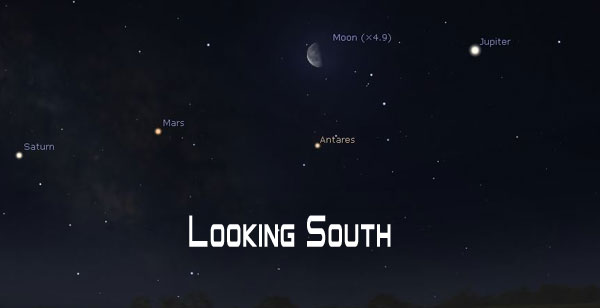
Credit: Stellarium
Mercury is the smallest and innermost planet in the Solar System. Its orbital period around the Sun of 87.97 days is the shortest of all the planets in the Solar System. Venus is the second planet from the Sun, orbiting it every 224.7 Earth days. It has the longest rotation period (day) of any planet in the Solar System and rotates in the opposite direction to most other planets.
Mercury is considered the most elusive planet to view since it is near the Sun. Venus is about 12 times brighter than Mercury. Mercury will reach its greatest eastern elongation (maximum angular separation from the setting sun) on March 15, 2018. At that juncture, Mercury and Venus will stay out about 80 minutes after the sunset. Watch for the young waxing crescent moon to swing by Mercury and Venus on March 18, 19 and 20.
Some areas of the Oregon coast will have headlands blocking your view to the south, where many of these planets appear. Stay a mile north of spots like Tillamook Head, Cascade Head (if you’re at Neskowin), or Cape Perpetua at Yachats.
If you’re in the Portland area, OMSI has daily showings of Starry Night Live! in the Kendall Planetarium. Visit: OMSI.edu. - Oregon Coast Lodgings for this event - Where to eat - Maps - Virtual Tours
Cannon Beach Lodging
Nehalem Bay Lodgings
Manzanita Hotels, Lodging
Three Capes Lodging
Pacific City Hotels, Lodging
Lincoln City Lodging
Depoe Bay Lodging
Newport Lodging
Waldport Lodging
Yachats Lodging
Oregon Coast Vacation Rentals
Oregon Coast Lodging Specials

More About Oregon Coast hotels, lodging.....
More About Oregon Coast Restaurants, Dining.....





LATEST Related Oregon Coast Articles
17 Sep 2026 at 7:06pm
Video recorded on 4th of July in Washington by the suspects. True crime
Police Seek Tips on Who Decapitated a Shark Found on Washington Coast
17 Sep 2026 at 7:06pm
These sharks are on the brink of endangered status. Ocean Shores. Marine sciences
N. Oregon Coast Rescue: Lost Boy Beach Lives Up to Its Name and Example of Wa...
17 Sep 2026 at 10:00am
Three visitors went beyond the boundaries of Oceanside into a dangerous cove. Safety, rescue
N. Oregon Coast's Deeper, More Rugged Parks Could Use Some Help: Tillamook Co...
15 Sep 2026 at 8:11am
County's push to elevate parks gaining major momentum, but seeking donations. Netarts, Oceanside, Nehalem, Rockaway Beach, Barview, Bayocean, Cape Meares, Pacific City
Two dead in separate Oregon coast crashes, one involved 17 people
14 Sep 2026 at 8:54pm
One happened near Cannon Beach the other along Hwy 30. Rescue, traffic
Oregon's Crave The Coast Returns in October, Month-Long Seafood Fest from Ast...
14 Sep 2026 at 8:52pm
All through Oct: Boat trips, cheese, ice cream, and major seafood. Garibaldi events, Astoria events, Seaside events, Warrenton events, Cannon Beach events, Manzanita events, Rockaway Beach events, Tillamook events, Pacific City events, Neskowin events
South Oregon Coast's Circles in the Sand Lands at Florence for Two Days
14 Sep 2026 at 8:50pm
Florence on October 24 and 25: Heceta Beach gets gigantic art
Start Looking Now for the False Dawn / Zodiacal Light Above Oregon, Washington
13 Sep 2026 at 8:39pm
Starting maybe two hours before dawn, the mysterious light likely from Mars. Astronomy, sciences, weather
Back to Oregon Coast
Contact Advertise on BeachConnection.net
All Content, unless otherwise attributed, copyright BeachConnection.net Unauthorized use or publication is not permitted
Oregon
Coast Lodging
Rentals
Specials
Search for Oregon Coast Subjects, Articles
Virtual Tours, Maps
Deep Details



















Oregon
Coast Lodging
Seaside
Cannon
Beach Lodging
Nehalem Bay Lodgings
Manzanita Hotels, Lodging
Rockaway Beach Hotels
Three Capes Lodging
Pacific City Hotels, Lodging
Lincoln
City Lodging
Depoe
Bay Lodging
Newport Lodging
Waldport Lodging
Yachats
Lodging
Oregon
Coast Vacation Rentals
Oregon
Coast Lodging Specials
Dining
Guide
Seaside
Cannon
Beach Dining
Manzanita,
Rockaway, Wheeler Dining
Pacific
City, Oceanside, Netarts, Tierra Del Mar Restaurants
Tillamook
Bay Restaurants, Dining
Lincoln
City Dining, Restaurants
Depoe
Bay Restaurants, Dining
Newport Restaurants, Dining
Waldport,
Yachats Restaurants, Dining
Florence Restaurants, Dining
Restaurant
Reviews
Coast
Events Calendar
Astoria
Seaside,
Cannon Beach Calendar
Manzanita,
Rockaway Events
Tillamook,
Pacific City Calendar
Lincoln
City Events Calendar
Newport,
Depoe Bay Events Calendar
Yachats Events Calendar
Oregon Coast Complete Guides every beach access, attraction
Search for Oregon Coast Subjects, Articles
Explore Every Beach Spot


News Headlines from All Over Oregon Need to scan Oregon headlines? Constantly updated news from all over Oregon: a comprehensive, up-to-the-minute display of news headlines from a variety of media
Oregon Coast Oceanfront Lodging, Hotels, Rentals
Book Coastal Lodging Now
Booking.com