



Oregon Coast's Influential, Tall Weirdos: Bull Kelp
Published 02/25/2020 at 12:28 AM PDT
By Oregon Coast Beach Connection staff
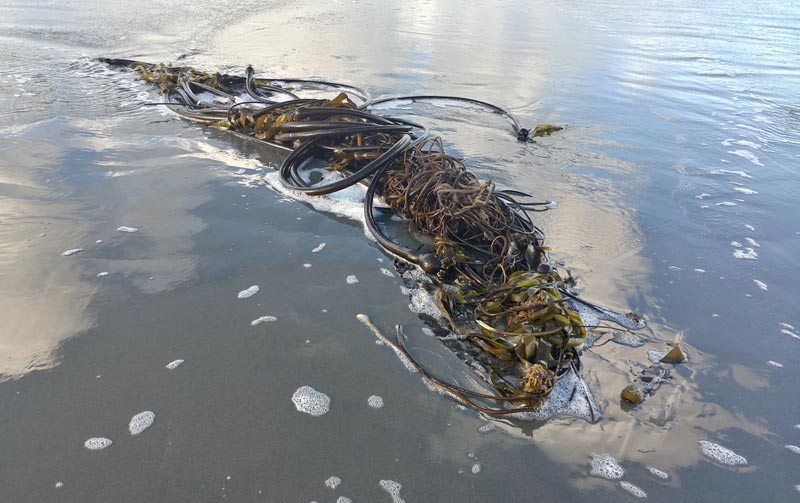
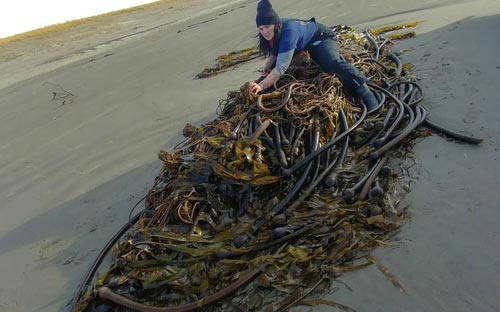
(Oregon Coast) – One of the more head-scratching wonders of the Oregon coast is those giant piles of weird-looking green / brown things with the bubble-like heads on them, usually showing up after storms have tossed a bevy of oddities onshore. They look like giant whips or maybe freaky dead creatures descended from octopuses that maybe you didn’t know anything about. (Photos courtesy Seaside Aquarium).
In other seemingly unrelated kooky moments, you may look down at the surf and see what look like seals floating in the ocean and possibly checking you out.
Also See Bull Kelp and Their Holdfasts: Wacky World of Upside Down Forests on Oregon Coast
Mitch Vance is a marine expert in the Newport office of Oregon Department of Fish and Wildlife (ODFW), working with its Marine Resources Program. He said what is often simply referred to as kelp is really just a broader term to describe any kind of macro algae, but they are technically known by their individual species names. In the case of the Oregon coast, it’s bull kelp you mostly see around these parts. There are all kinds of macro algae out there: brown algae, green, red, etc.
Here, however, you’re seeing bull kelp (Nereocystis luetkeana), and to a much lesser extent, giant kelp (Macrocystis sp.).
“There are several species in Oregon, but bull kelp forms the major kelp forests offshore,” he said.
Kelp is a macro algae – but what is a macro algae?
“It’s a marine plant,” he said.
There are many different kinds in different areas offshore.
“It’s a broad topic,” Vance said. “Then there’s micro algae: that’s the phytoplankton that lives in the ocean, free floating, that forms the basis – the beginning – of the food chain in the ocean.”
These wacky giant plants create what can be described as “upside down forests,” with their thicker parts down at the bottom.
Vance said they stick themselves to reefs or rocky places just beneath the surface.
“They are attached to the bottom of the ocean with a holdfast, attached to rocks on the bottom,” he said. “Then they grow up towards the surface with a float and then grow leaves – the fronds. Those stalks are 30 feet to 40 feet long.”
The bulbs are filled with carbon monoxide, which allows them to float. The holdfasts at the bottom are not like roots of regular plants as they don’t absorb nutrients. It’s the fronds coming from farther up the plant that do that, absorbing sunlight through photosynthesis.
“The water depth is just right so they can attach to the bottom and grow up into the light zone and continue to grow,” Vance said. “Because of it’s too deep they’ll never get enough light.”
This helps explain why you only see them in a few select spots along the Oregon coast. Near Cannon Beach’s Silver Point and the Cape Falcon area perhaps at times, but they really show themselves at the reefs just off Depoe Bay and down around Cape Foulweather.
Those spots have to be just the right difference between rocky reef and ocean surface.
On the southern Oregon coast there’s a few as well. Dave Lacey, South Coast Destination Coordinator with Oregon Coast Visitors Center, said they can easily be seen in that area.
“Cape Arago is a great spot for that,” Lacey said. “Also around Orford Heads can be good too. North of the Chetco River at Chetco Point is another good spot.”
Vance said those kelp forests are literally everywhere along the coastline, however. They just may not be in full view of humans.
Around Depoe Bay they’re partially the cause of something rather spectacular: whales. All those gray whales that linger in that area, making for “resident whales,” are attracted to all the mysid shrimp in the area. Billions of them linger here at a time, attracted to the kelp forests because it’s a place they can hide a bit.
Depoe Bay whale scientist and whale tour operator Carrie Newell made that discovery back in 1999, when she realized the whales were hovering over the reefs of the Depoe Bay and Newport areas, and not muddy bottoms (where many of their food sources often live). She had a hunch they were scarfing down loads of these tiny crustaceans (which, by the way, are not really shrimp but have that name). After collecting whale poop and analyzing it, Newell discovered that – voila – it was mysid shrimp indeed.
Bull kelp have also formed relationships with other sea creatures, Vance said. Other creatures apparently hide in there, including rockfish.
“Urchins and abalone and other grazers will eat all species of kelp and marine algae,” Vance said. “Sometimes they wait until leaves break off. Urchin may nibble away at the bottom of the stalk and detach that kelp, and eat it that way.”
Bull kelp have an interesting life cycle – including some of the zippiest growth out there. Sometimes they grow by as much as two feet a day. According to Tiffany Boothe of Seaside Aquarium, they start out as small spores in the spring but by summer have reached full size, then often die in the winter when storms come and rip them out.
Oregon Coast Hotels for this - Where to eat - Map - Virtual Tour
While there’s lots of kelp beds everywhere, they are patchy, Vance said. They seem to be getting even patchier, thanks to growing environmental issues.
“Kelp beds are annual and have not been doing very well in some spots lately due to warmer ocean temperatures,” he said.
Cannon Beach Lodging
Nehalem Bay Lodgings
Manzanita Hotels, Lodging
Three Capes Lodging
Pacific City Hotels, Lodging
Lincoln City Lodging
Depoe Bay Lodging
Newport Lodging
Waldport Lodging
Yachats Lodging
Oregon Coast Vacation Rentals
Oregon Coast Lodging Specials

More About Oregon Coast hotels, lodging.....
More About Oregon Coast Restaurants, Dining.....


LATEST Related Oregon Coast Articles
25 Sep 2026 at 9:55pm
Large moon - but there's a catch - and some meteor showers. Weather, Astronomy
Late-Night Rescue on Cape Lookout Trail Highlights Oregon Coast Hiking Hazards
25 Sep 2026 at 9:51pm
Oceanside-area rescue after dark: responders offer advice. Safety, Netarts, Oceanside tunnel, Lost Boy Beach
Another Fatal Accident on Oregon Coast Last Weekend, This Time Involving Pede...
25 Sep 2026 at 9:22pm
Gleneden Beach: A Portland man hit first by one vehicle and then by two more. Lincoln City, safety
Active Winds Along Oregon Coast, Cascades and Valleys: Touch of a Fall Storm
25 Sep 2026 at 9:22pm
UPDATES: High Wind Advisories in Valley, Gorge. Gale watch along the coast, brief thunderstorms in NW Oregon possible. Weather
South Oregon Coast Wilderness: Tseriadun State Scenic Rec Site, Paradise Poin...
24 Sep 2026 at 7:21am
Four miles of crazy finds, yet another Agate Beach, an angry river and Cape Blanco. Port Orford, Curry County
Two Deadly Crashes This Weekend Near Oregon Coast, Including 4-Month-Old Girl
23 Sep 2026 at 9:11am
One happened near Florence and the other outside of Myrtle Point near Bandon. Traffic, rescue
Florence's 5th Annual Festival Books Opens New Pages to Oregon Coast This Wee...
23 Sep 2026 at 8:11am
Florence's literary community on Saturday, September 26. Florence events
Search Suspended for Missing Pilot Off Oregon Coast - Newport
22 Sep 2026 at 9:28am
The 78-year-old crashed into the Pacific near 1 pm. Coast Guard. Astoria Coast Guard, North Bend Coast Guard
Back to Oregon Coast
Contact Advertise on BeachConnection.net
All Content, unless otherwise attributed, copyright BeachConnection.net Unauthorized use or publication is not permitted
Oregon
Coast Lodging
Rentals
Specials
Search for Oregon Coast Subjects, Articles
Virtual Tours, Maps
Deep Details








Oregon
Coast Lodging
Seaside Hotels
Cannon
Beach Hotels
Nehalem Bay Lodgings
Manzanita Hotels, Lodging
Rockaway Beach Hotels
Three Capes Lodging
Pacific City Hotels, Lodging
Lincoln
City Lodging
Depoe
Bay Hotels
Newport Hotels
Waldport Lodging
Yachats
Lodging
Oregon
Coast Vacation Rentals
Oregon
Coast Lodging Specials
Dining
Guide
Seaside
Cannon
Beach Dining
Manzanita,
Rockaway, Wheeler Dining
Pacific
City, Oceanside, Netarts, Tierra Del Mar Restaurants
Tillamook
Bay Restaurants, Dining
Lincoln
City Dining, Restaurants
Depoe
Bay Restaurants, Dining
Newport Restaurants, Dining
Waldport,
Yachats Restaurants, Dining
Florence Restaurants, Dining
Restaurant
Reviews
Coast
Events Calendar
Astoria
Seaside,
Cannon Beach Calendar
Manzanita,
Rockaway Events
Tillamook,
Pacific City Calendar
Lincoln
City Events Calendar
Newport,
Depoe Bay Events Calendar
Yachats Events Calendar
Coastal
Bars, Lounges
Southern Oregon Coast
Washington Coast
Oregon Coast Complete Guides every beach access, attraction
Search for Oregon Coast Subjects, Articles
Explore Every Beach Spot

News Headlines from All Over Oregon Need to scan Oregon headlines? Constantly updated news from all over Oregon: a comprehensive, up-to-the-minute display of news headlines from a variety of media
Oregon Coast Oceanfront Lodging, Hotels, Rentals
Book Coastal Lodging Now
Booking.com