BEACH
NEWS YOU CAN USE
Two Birds Rescued by Oregon Coast Aquarium
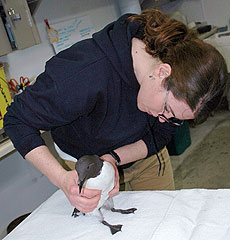
(Newport, Oregon) - Two birds were recently rescued by the Oregon Coast Aquarium, which were brought in for medical care and rehabilitation after receiving injuries in the wild. One bird, a common loon, was ensnared in a tangle of fishing line and was in danger of dying. The other bird, a common murre has a wing injury of unknown origin. Karen Anderson, Aquarium Curator of Birds, says birds that become entangled in fishing line often do not survive. "If you watch the loon diving in its holding pool, it's easy to see how it can become entangled. This demonstrates the need for people to be very careful while fishing. Lost line and tackle are common causes of fatalities in marine animals.”
Another serious problem caused by fishing tackle is ingestion of lead sinkers. "Loons and other waterfowl eat gravel to aid digestion, and lead sinkers resemble gravel,” said Anderson. “Ingestion of just one sinker will eventually kill them. Fortunately, fishing line sinkers made of non-toxic metals are now available." The common loon has a dagger-like beak that is perfect for underwater fishing, diving to depths of over 90 ft. The loon is most closely related to primitive birds, and its soliloquy of cries has a haunting sound. True to its reclusive and solitary nature, the loon prefers a secluded lake or estuary. It is an excellent swimmer and can stay underwater for long periods. The common murre is distinctive in the way it stands
upright like a small penguin. Because seabirds spend so much time
on the surface of the water, and because they congregate in large
groups for nesting, they are threatened by oil spills. Murres dive
deep, which puts them in danger of being trapped in gill nets and
fishing hooks and line, where they can drown.
The aquarium is able to provide aid for injured marine animals on a limited basis. Greg Starypan, the Aquarium's Director of Annual Support, says that rescuing and caring for distressed wildlife is especially costly for the Aquarium. "Injured, sick, or newborn animals typically require 24-hour-a-day care," says Starypan. "Rehabilitation can last up to several months and cost several thousands of dollars for a single animal in labor costs alone." The Oregon Coast Aquarium has rehabilitated and released (when possible) injured seabirds, tropical sea turtles, and marine mammals including various endangered species. Although many of these distressed animals are in such poor condition when they arrive that they do not survive, there are those that are successfully rehabilitated and returned to the wild. People who find an injured animal are asked not to touch it or bring it to the Aquarium, but to call the Aquarium or Oregon Department of Fish & Wildlife. If you would like to help support the Aquarium's rehabilitation efforts, please call (541) 867-3474 ext. 5228. (Photos by Cindy Hanson, courtesy Oregon Coast Aquarium) |
||||||||||
 Family
Fun
Family
Fun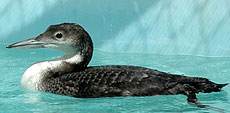

RELATED STORIES
Geologic Wonders of Oregon Beaches Make Freaky History Lesson Beneath the sands and deep inside the cliffs, there's more to the coast
Oregon Travel Secrets: Weird Science, Spring Rarities on the Coast The 'secret season' and other spectacular oddities abound
Taste-Testing Tourism on the North Oregon Coast Numerous lodging, dining and beach secrets lurk here
'Ocean Burps' Leave Oddities on Seaside Beaches A semi-regular natural occurrance is leaving strange things on the beach
Oregon Tourism Alert: Spring Rarities in Newport Much is new in Newport, especially in the natural world
BREATHTAKING
CLIFFTOP IN NEWPORT STARFISH
POINT
is located on the Central Oregon Coast - in Newport - and offers
only the finest in luxury condominium lodging. At Starfish Point,
every unit is focused on the beauty of the sea and the beach. |
SPECIAL
SECTIONS |
|||||||||||||
| calendar of events | lewis & clark guide | |||||||||||||
| beach news | weather | |||||||||||||
| editor's adventure blog | |||||||||||||
| columnists: guy ditorrice (general) | peg miller (shopping) | |||||||||||||
| coastal pubcrawl | Important Links | |||||||||||||
| coastal science | kooky coast | |||||||||||||
OR
TAKE THE VIRTUAL TOUR |
|||||||||||||
|
 ASTORIA
 SEASIDE
 CANNON
BEACH
CANNON
BEACH NEHALEM
BAY
NEHALEM
BAY TILLAMOOK
BAY
TILLAMOOK
BAY THREE
CAPES LOOP
THREE
CAPES LOOP LINCOLN
CITY & THE CORRIDOR OF MYSTERY
LINCOLN
CITY & THE CORRIDOR OF MYSTERY DEPOE
BAY
DEPOE
BAY NEWPORT
 WALDPORT
/ SEAL ROCK
WALDPORT
/ SEAL ROCK YACHATS
 UPPER
LANE COUNTY
UPPER
LANE COUNTY FLORENCE
Cannon Beach Ecola Creek Lodge |