BEACH
NEWS YOU CAN USE
Covering 160 miles of Oregon Coast: Seaside,
Cannon Beach, Manzanita, Nehalem, Wheeler, Rockaway, Garibaldi,
Tillamook, Oceanside, Pacific City, Lincoln City, Depoe Bay, Newport,
Wadport, Yachats & Florence.
Deep Inside Seaside's Aquarium
(Oregon
Coast) - On
Oregon's north coast, the historic landmark Seaside Aquarium still
provides fun in an aquatic way after 70 years.
Sea
cucumbers. Sea lemons. Sea lettuce. These are the words I hear from
Seaside Aquarium staff recently. What is this??? Some kooky seafood
salad recipe?
Manager
Keith Chandler says this is among his bounty for the day, after
having gone down to Netarts Bay - on the Oregon Coast - and grabbed
a few species for the aquarium. He holds up a sea cucumber to my
face and makes motions like it's moving to attack me - in a parody
of an old horror flick or something. This purplish, bumpy freaky
thing, it turns out, is related to starfish and sand dollars (pictured
here).
All this takes
me back to my first tour of the historical landmark - the Seaside
Aquarium, in the northern Oregon coast resort town of Seaside.
It's early summer 2004, and the aquarium was just the recipient
of five brand new seal pups born in recent months. I, and a couple
others from the local paper, receive a little tour of the facility,
getting a chance to look at the nearly 70-year-old aquarium.
The seal pups splash and cavort, their adorable
little faces wowing the three of us press-types and causing us to
constantly coo, "they're so cute." Four were named Wyatt,
Ivar, Travis and Sarah. A fifth was named Reagan, born on the day
the former president died. The others were named after members of
the family which has owned the aquarium since the 30's. Ivar was
named after a branch of the family that started the Ivar's Fish
& Chips empire in Washington State.
Another
two were born a few months earlier, named Lewis & Clark, after
the explorers who some two centuries ago actually wandered around
the area that would become this town.
Part of the eternal big fun of the aquarium is feeding
the seals, which visitors can do after purchasing a cheap bag of
yummies for these water-slapping, barking and comical creatures.
Keith tells me all the seals are related, breeding
with cousins and other family members, but says this hasn't degenerated
their gene pool - yet - and there are no signs it will.
We wander to
the tanks that the public sees - except we're above, where they
open the tanks to feed the fishies. He gets me to stick my hand
into the octopus tank and touch the suction cups on the tentacles.
There's a little sticking action to my hand, but not much. Still,
it doesn't take much for me to get a little creeped out and my hand
doesn't stay for long.
"They've
each got their own, different personalities," Keith says. He
calls them almost as stubborn as seals. They seem to like some staff
members more than others, getting in their way while working in
the tank or not cooperating if the octopus decides he doesn't dig
you.
Inside
this behind-the-scenes area, it's like a labyrinth of wooden structures,
walkways above you, corridors of tanks and other functional equipment.
It's a little spooky, actually. All around are old, old remnants
of the aquarium's history, including a sign about Clara the seal,
who had a messed up-looking eye. It stated she was in no pain, and
that one of her favorite tricks was to put her flippers to her mouth,
showing tourists she wanted to be fed. Clara died in 1978, Keith
says.
This place was actually a natatorium in the 20's,
until the Depression killed its economic feasibility in the early
30's. This was a warm, saltwater public bath, with water pumped
in from the sea through a pipe (still visible today at the tide
line) and then heated. Around the walls were balconies so people
could watch others swim in the pool below. For a time, the place
served as a salmon rearing facility, and then a place to watch wrestling
matches.
The aquarium was started in 1937, making it one
of the oldest in the entire nation.
Keith
leads us down a stairway some ten feet to a dank-smelling basement,
with three giant holes in the ground, filled with rocks. This is
the former deep end of the pool, Keith says, and the holes are the
filters for the seawater that feeds into the tanks. Each hole spills
into another, until water is finally pumped from the bottom of the
third filter. Without that, he says, the water would be too murky
for the public to see into the tanks.
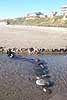
That pipe is still used to bring water into the
aquarium, lying six to 20 feet under the sand, depending on its
location. Regular visitors to the area will notice it occasionally
changes shape out on the tide line. This is because sands shift
and they need to periodically reconfigure it to keep it from being
smothered.
Fast forward again to the day I encounter Keith
after his trip to Netarts. I'm hanging out behind the scenes again,
and his assistant Tiffany shows me a little yellow critter called
a sea lemon. If you smell it closely, it does smell a bit like a
lemon. There are, apparently, also creatures called sea lettuce
on reefs.
Tiffany
holds up a sea cucumber, and out of curiosity I move close to sniff
it. This place is full of pranksters, and Tiffany says, "you
almost kissed a sea cucumber" - admitting she almost shoved
it into my face.
They show me starfish, including one type with really
long arms. Keith demonstrates how they stick to things by letting
it suction itself to his hand. When he pulls it off, a few of the
little "feet" come off. These regenerate, he says. Tiffany
adds that they have two sets of eyes at the end of each arm.
The public area of the aquarium showcases dozens
of sea species, along with a touch tank and the opportunity to feed
those adorable seals. There's nothing like just hanging out, having
fun with pranksters and still learning something.
I did, however,
get my own prank in: I crank called Keith's cell phone a week later.
200 N. Prom, Seaside, Oregon. www.seasideaquarium.com
(503) 738-6211.
|