 |
 |















Oregon Coast Abuzz Over Photos of Green Flash, Glowing Sand
Published 08/26/2006
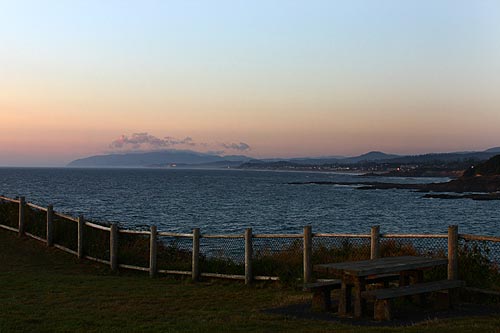
Look to sunsets and just after the sun goes down for wild oddities on the coast (pictured here: near Depoe Bay)
(Oregon Coast) – Two major – and extremely difficult to document – natural phenomena were captured on camera recently, creating a major buzz in Oregon's tourism and science worlds.
The phenomena are so singular and rarely photographed, the events themselves verge on the paranormal.
In Seaside, a 23-year-old woman managed to snap a picture of the extremely difficult “glowing sands” that has been wowing tourists to the Oregon coast this summer. In Newport, a restaurant owner snapped a shot of the rarely photographed “green flash” – and not just any green flash, but an exceptionally infrequent version of it.
In early August, Tiffany Boothe, with the Seaside Aquarium, embarked on a minor journey of discovery on the beaches of Gearhart after dusk to try and spot the “glowing sands” event and take photos of it. To the naked eye, this phenomenon looks like faint, greenish, blue sparks underneath your feet in the wet sand.
What her camera caught was a couple of blue dots. While that may seem ridiculously uninteresting to those first viewing the photo, it is indeed an accomplishment when you realize the creatures that cause this are microscopic, they flash their bioluminescence for less than a second and when you take in the other factors that make this photographically nearly impossible to capture.
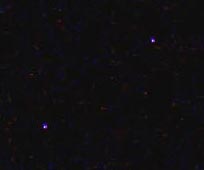 |
| Faint and vague: however, Boothe did catch these two dots - the "flashing" phytoplankton |
The creatures are a form of phytoplankton called dinoflagellates – part of the family of microscopic plants that form the bottom of the food chain for marine life. This particular brand is bioluminescent, meaning they give off a glow when disturbed or bumped through internal chemistry processes, much in the same way a firefly does.
They tend to hit Oregon’s beaches in warmer periods when nutrients can be more abundant and more sunlight can help “charge them up.”
The luminescence of a single dinoflagellate lasts for 0.1 seconds, which is why photographing the phenomenon is so next to impossible. Larger organisms, such as jellyfish, can be luminescent for tens of seconds.
When Boothe tried photographing this, most shots came out with nothing or nearly nothing. She and two friends grabbed jars and poured wet sand that had the dinoflagellates into jars. They then tried shaking the jars. But the flashes happen too fast for a long exposure to catch – and a long exposure is what it would take to catch such a faint glow.
Still, she managed to capture these two blue dots. The area seen in this photo is less than an inch in circumference. The photo was shot as the group was pouring the sand into the jar, not when they shook the jar. Boothe said the dinoflagellates sparked much more during the pouring process.
 |
| Boothe and friends pouring sand with the glowing phytoplankton in their attempts to get the photo above |
“Bioluminescence is the light produced by a chemical reaction that occurs in an organism,” said Boothe. “It occurs at all depths in the ocean, but is most commonly observed at the surface. Bioluminescence is the only source of light in the deep ocean where sunlight does not penetrate.”
Boothe said bioluminescence in sea creatures is blue for two reasons. One, blue/green light travels the farthest in water. “Its wavelength is between 440 to 479 nm, which is mid-range in the spectrum of colors,” Boothe said. “And the second reason is that most organisms are sensitive to only blue light. They do not have the ability to absorb the longer or shorter wavelengths of other lights such as red.”
To see the glowing sands, you must have a very dark beach with little or no light interference from lamps on land or the moon. They can appear in bays, like Nehalem Bay or Yaquina Bay. When you run your hand through the water it will manifest an eerie bluish glow. For further explanation, click here
In Newport, restaurant owner Bob Trusty loves to photograph the lush sunsets of Nye Beach, especially from the perch above the Nye Beach Turnaround where his Village Market & Deli sits.
Earlier this summer – July 10 to be exact – he happened to catch a form of the much-revered “green flash” at sunset, a rare occurrence where a green blob appears at the upper edge of the sun just before it dips below the horizon. In Trusty’s case, he caught a version of this oddity called the “green ray,” where shafts of blue or green light come streaming out from the sun just before it goes away.
Trusty was filled with glee over the event. “That was one of the coolest things,” he said. “I couldn’t really believe I’d gotten it at first. It’s really rare to be able to catch things like that. I was really, really lucky.”
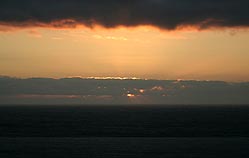 |
| Trusty's "green ray" photo, July 10, 2006 |
The phenomenon usually appears as a tiny tip of the sun appearing green just a few seconds before it’s gone. The shape is sort of oblong, while flattened at the bottom. There are other types of green flashes that appear in other shapes, slightly longer periods or other colors such as red, violet or blue.
Trusty caught one of the more rare types, called the green ray, where shafts of darkly colored sunlight spring out from clouds or coastal fog. This is even more significant because the green ray is rarer than the other forms, and even rarer still are instances where this occurs while banks of clouds are in the way. Normally, forms of the green flashes only happen with clear and unobstructed views of the sunset.
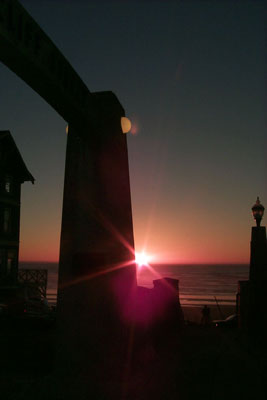 |
| Nye Beach's architecture creates interesting ways to photograph sunsets |
According to one website created by Andrew Young of San Diego University, if you know what to look for, these phenomenon are not that rare at all, but it can be seen in “most sunsets,” as Young put it.
This effect is the result of refraction in the atmosphere. In very simplified terms, longer bandwidths of light get knocked out by atmospheric conditions until you’re left with just green – or whatever color is the result of this situation. Basically, the path between your eye and this portion of the sun are filled with just the right conditions to cut out these colors of the sunset.
This happens almost as often with sunrises as well. Mostly what is needed is a clear, long path between you and the sunset for this mirage to appear, such as a desert or body of water like the ocean.
More About Oregon Coast hotels, lodging.....
More About Oregon Coast Restaurants, Dining.....
 |
 |

 |
 |
 |
 |
 |
 |
LATEST OREGON COAST NEWS STORIES
RELATED STORIES
|
Back to Oregon Coast
Contact Advertise on BeachConnection.net
All Content, unless otherwise attributed, copyright BeachConnection.net Unauthorized use or publication is not permitted


Secrets of the Season |

Unusual Travel Articles TravelParanormal.com allows you to submit your own creepy tale or debunk one - or see up-to-the-minute news headlines about travel and the paranormal. News Headlines from All Over Oregon Need to scan Oregon headlines? Constantly updated news from all over Oregon: a comprehensive, up-to-the-minute display of news headlines from a variety of media |